
Aircon Service · Singapore
Aircon Gas Top-Up in Singapore
From $90. Refrigerant top-up for R22, R410A, and R32 systems — restores cooling when gas runs low.
What is an aircon gas top-up?
Refrigerant — the gas circulating between your indoor and outdoor units — is what actually carries heat out of your room. When refrigerant levels drop, the compressor keeps running but no longer moves heat efficiently, so the air from your vents stops feeling cold.
A gas top-up adds refrigerant back into the system. It is a quick fix that restores cooling immediately — but refrigerant does not get used up like fuel. If your aircon keeps needing top-ups, there is a leak somewhere that needs to be found and repaired, or you are paying for the same gas twice.
Signs you need a gas top-up
These are the symptoms of low refrigerant — different from a dirty coil, which calls for chemical wash instead.
Warm or weak air with compressor running
The fan still blows, but the air no longer feels cold — the most common symptom of low refrigerant.
Hissing near the indoor unit or pipework
A faint hiss often means gas is escaping through a leak in fittings or copper pipes.
Frost or ice on the copper pipes
Visible frost or ice forming on the refrigerant lines is a sign the system is running out of balance.
After installation or pipework changes
Recent install, relocation, or repair work can release some refrigerant — a top-up restores pressure.
Aircon not as cold as it used to be?
Low gas is one possible cause. WhatsApp us what the unit is doing and we will tell you what to check first.
We check for a leak before we add gas
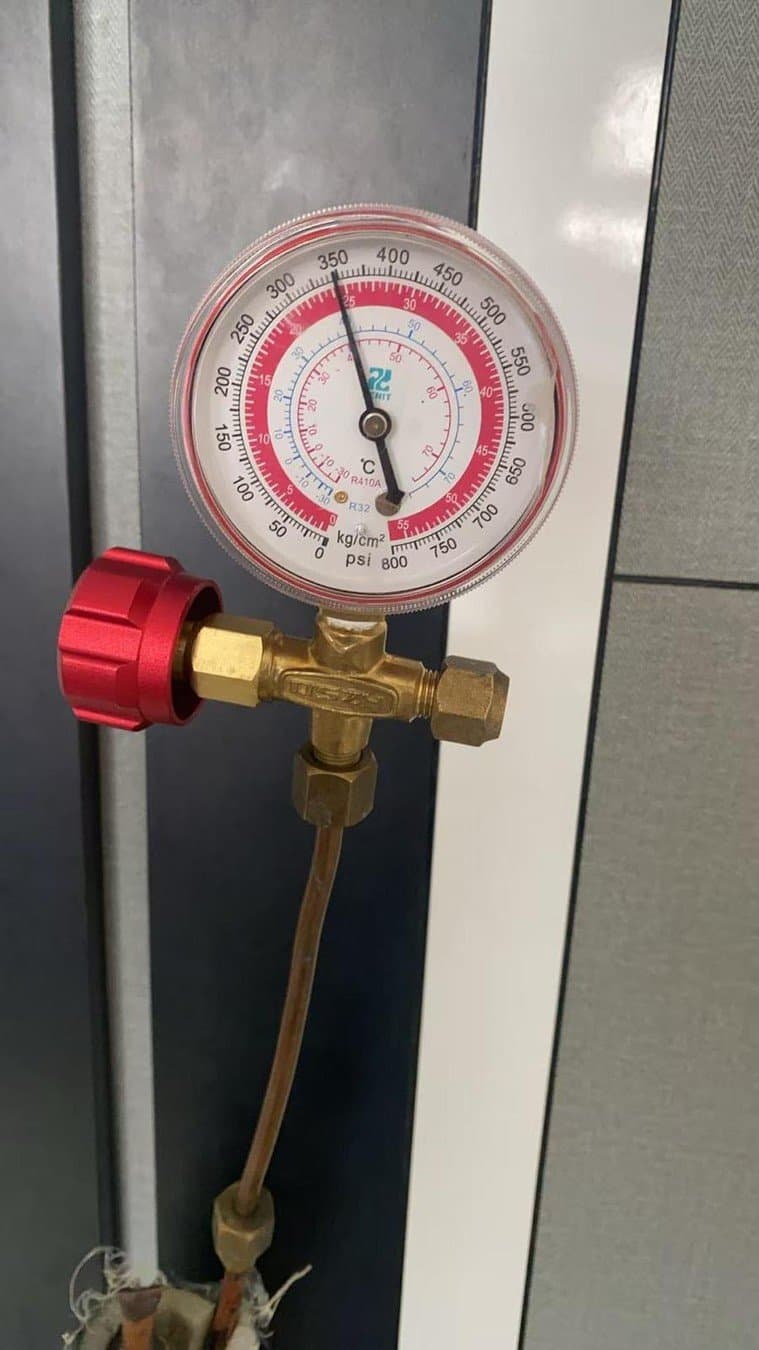
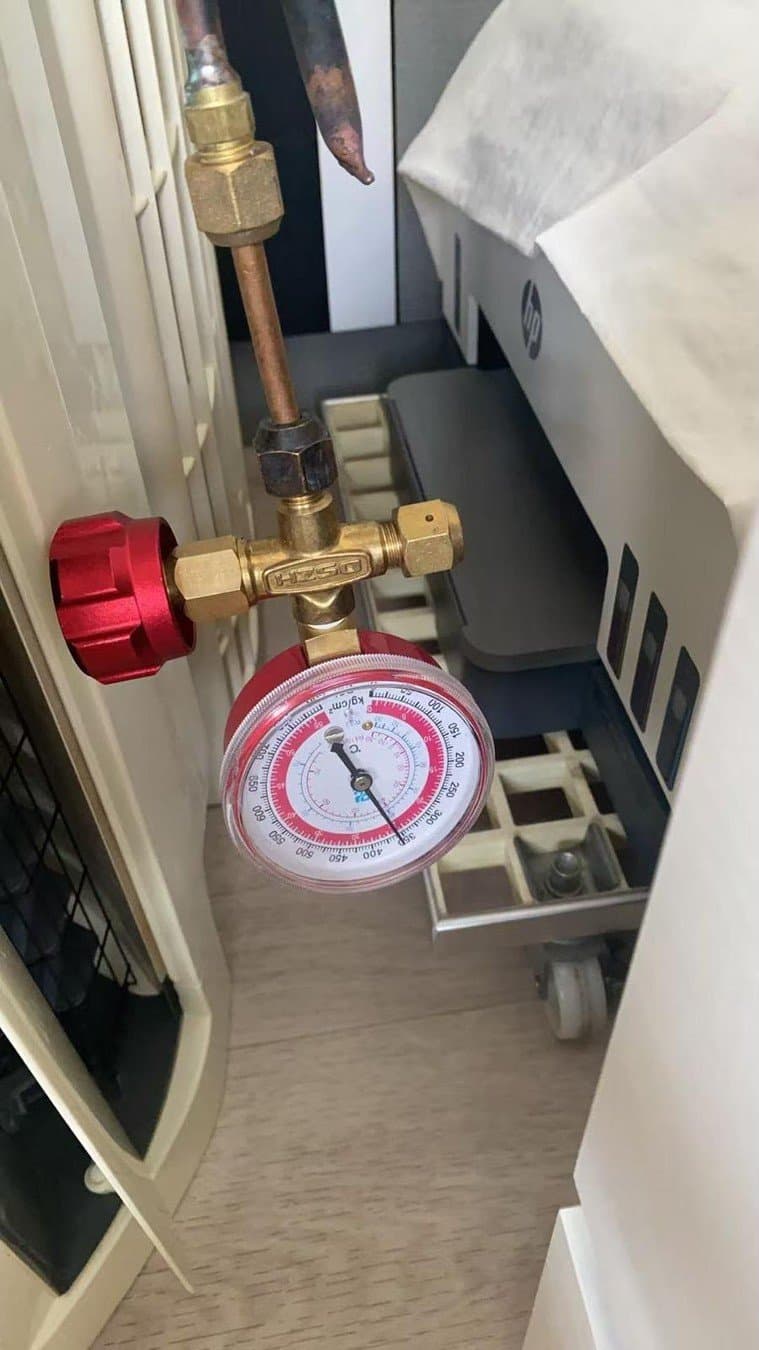
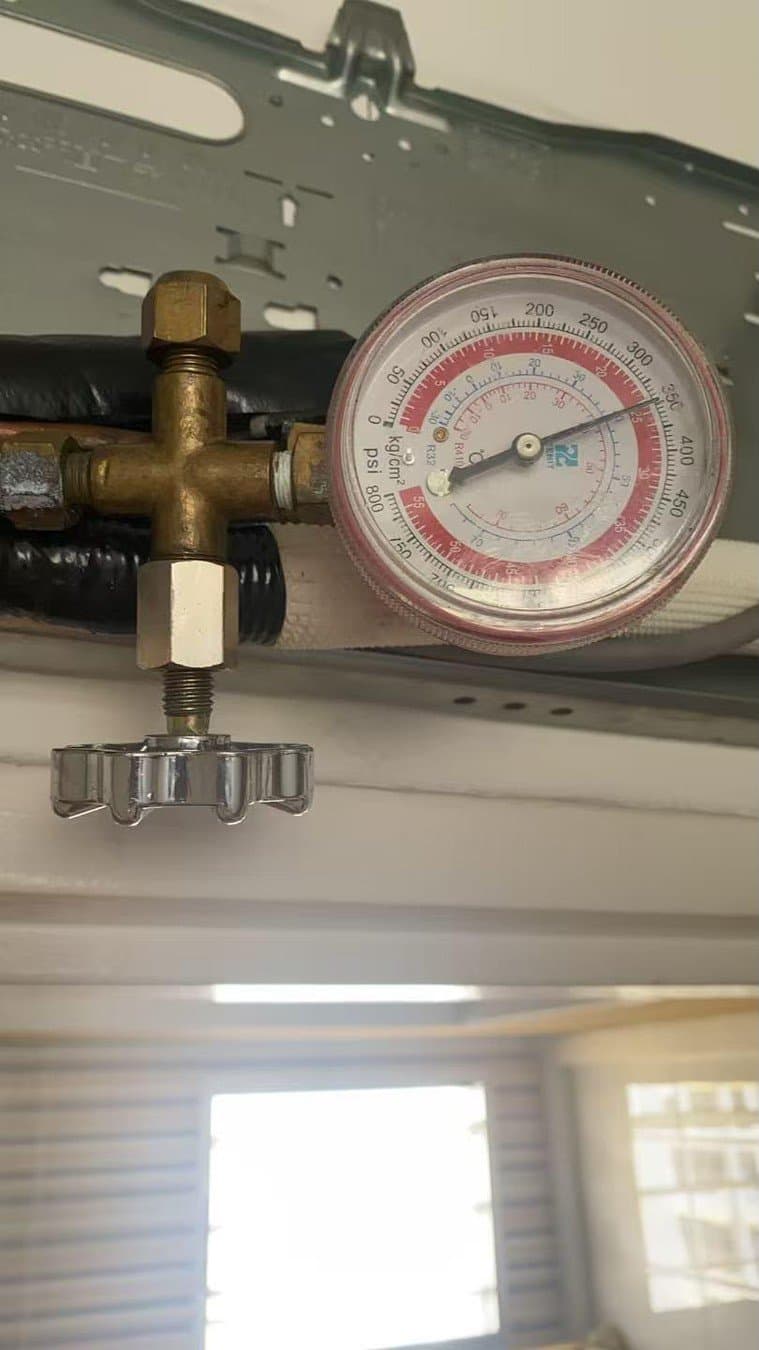
These photos are from a recent job. The customer's aircon was running, but the air coming out was not cold. The airflow was fine, so the next thing to check was whether refrigerant was escaping somewhere.
We connected a gauge to the service valve on each unit, brought the system up to pressure, then left it and came back to read it. If the needle holds, that unit is sealed. If it drops, there is a leak, and we know which unit to open up. Topping up without doing this just means paying for the same gas again in a few months.
Worth knowing before anyone tops up your gas
- • Refrigerant does not get used up. A sealed system holds its charge for years. If you are told you need a top-up every year, ask where the gas is going.
- • Gas can be let out through the same valve it is charged through. Be in the room while the work is done, and ask to see the gauge before and after.
How a gas top-up works
What happens when we come to check your aircon gas.
- 1
Check it really is the gas
If the fan blows well but the air is not cold, low gas is one possibility. A clogged filter or a dirty coil can feel the same, so we rule those out first.
- 2
Read the pressure
We connect a gauge to the service valve on the outdoor unit. The reading shows whether the system is low, and by how much. That reading also sets the price.
- 3
Find out why it is low
Gas does not get used up, so low gas means it escaped somewhere. We check the joints and valves, and pressure-test the system when the leak is not obvious.
- 4
Top up to the right level
We add the refrigerant your unit was built for (R22, R410A or R32) up to the correct pressure. Overfilling is as bad for the compressor as running low.
- 5
Test and show you the gauge
We run the aircon until the air coming out is cold again, and show you the gauge reading before we leave.
Three refrigerant types
Each refrigerant has different properties and price. The type is printed on the outdoor condenser nameplate.
R22
Older systems (pre-2010)
Production phased down globally. Cheapest to top up at low PSI, but units running R22 are usually nearing end of life.
R410A
Mid-era (2005–2015)
Common transition refrigerant. Mid-priced top-ups across all PSI ranges.
R32
New systems (2015+)
Standard on most modern units. Most expensive to top up, but more efficient than older refrigerants.
Gas top-up for HDB, condo, landed and office
The job is the same, but the kind of system you have changes what we check. Not sure which system you have? See the types of aircon explained.
HDB flats and condos
Most use a multi-split system: one outdoor unit on the aircon ledge serving two, three or four rooms (System 2, 3 or 4). A leak on that system affects every room it feeds, which is why several rooms can lose cooling at the same time.
Landed homes
Usually several outdoor units, often a mix of multi-split and single-split. We test each system separately, so only the one that is actually low gets topped up.
Offices and shops
Single-split and multi-split systems are priced from the table below. Larger systems such as VRV/VRF are quoted separately after we see them.
Gas top-up pricing
Price depends on refrigerant type and how much gas the system needs (measured in PSI). All prices in SGD.
| PSI Range | R22 | R410A | R32 |
|---|---|---|---|
| < 40 PSI | $90 | $120 | $130 |
| 41 - 80 PSI | $110 | $140 | $150 |
| > 81 PSI | $130 | $160 | $170 |
* Prices apply to single-split and multi-split aircon systems only. Larger systems (e.g. VRV/VRF) are quoted separately.
Lower PSI = less gas in the system = lower top-up price. The technician takes the PSI reading on-site before confirming the price.
Book a gas top-up
Tell us the brand, how many units and which area you are in. A top-up is $90 to $170 depending on the gas and pressure.
Gas top-up — FAQs
How do I know if my aircon needs a gas top-up?
How much does an aircon gas top-up cost?
Which refrigerant does my aircon use?
Why does my aircon keep needing gas top-ups?
Do I need a gas top-up every year?
Can I see the gauge reading myself?
Can you do gas top-up on the same visit as servicing?
Other aircon services
Aircon Cleaning
General service, chemical wash, or overhaul — depending on how dirty the unit is. From $55 per unit.
General Servicing
Routine maintenance to keep cooling strong. From $55 per unit.
Servicing Packages
Recurring maintenance contracts — scheduled visits from $115 per year (2 units).
Chemical Wash
In-place deep clean that clears mould and musty smells. From $110 per unit.
Chemical Overhaul
Full disassembly deep clean for neglected units. From $150 per unit.
Condenser Cleaning
Outdoor unit cleaning to recover cooling capacity. From $50.
Aircon Repair
Diagnosis and repair of leaks, noise, and cooling faults. From $50.
Aircon Installation
New systems, replacements and relocation. Quoted after a site check.
Aircon gas top-up across Singapore
We provide aircon gas top-up island-wide — same transparent pricing, no out-of-area surcharge. Find your area:
Book a gas top-up today
Same-day service available. Get a quote in minutes on WhatsApp.